

Industrial LED Linear Fixture Lighting: Complete Selection and Application Guide
When facility managers and electrical specifiers plan an industrial lighting upgrade, the first question is almost always "high bay or linear?" — and the answer depends on far more than ceiling height. Beam distribution, aisle geometry, mounting constraints, glare sensitivity, and future maintenance access all factor into a decision that directly affects worker productivity, safety compliance, and long-term operating costs.
This guide covers the technical fundamentals of LED linear fixtures for industrial environments, explains when and why linear luminaires outperform round (UFO) high bays, provides specification criteria for selecting the right fixture, and details how Recolux Lidu21 linear fixtures address the specific challenges of production floors, sports halls, and low-to-medium height industrial spaces.
What Is an LED Linear Fixture — and How It Differs from Other Industrial Lights
An LED linear fixture is a rectangular or elongated luminaire that distributes light along a continuous axis rather than from a single point source. Unlike UFO (round) high bay lights, which emit a radially symmetric beam from a compact circular housing, linear fixtures produce an elongated beam pattern that naturally aligns with aisle layouts, production lines, and long work zones.
This geometric difference is not cosmetic — it fundamentally changes how light interacts with the space below:
Aisle alignment: A linear fixture oriented parallel to a warehouse aisle delivers uniform illuminance from rack face to rack face with fewer units. A UFO high bay in the same aisle creates a circular footprint that over-lights the center and under-lights the rack faces.
Glare control: Linear fixtures allow directional optics (narrow, medium, wide beam angles) that can be selected per application, reducing direct glare at worker eye level.
Shadow reduction: The elongated source geometry creates softer shadows on vertical surfaces (rack faces, machine panels), improving task visibility for pick-and-place operations and quality inspection.
Linear vs. UFO High Bay: When Each Wins
The choice between linear and UFO high bay fixtures is not binary — it is determined by four primary factors: ceiling height, space geometry, task type, and mounting constraints.
By Ceiling Height
| Ceiling Height | Recommended Fixture | Reason |
|---|---|---|
| 3–6 m (10–20 ft) | LED linear fixture | Wide beam spread at low height avoids hot spots; linear geometry fills aisle width efficiently |
| 6–10 m (20–33 ft) | Either, depending on layout | Narrow aisles favor linear; open production floors favor UFO at moderate spacing |
| 10–15 m (33–50 ft) | UFO high bay | Compact circular beam at height provides sufficient coverage; linear fixtures may under-deliver at this range |
| 15 m+ (50 ft+) | UFO high bay (high-power) | Concentrated downward beam required; linear elongation provides no advantage at extreme height |
By Space Geometry
Narrow aisles (width ≤ 3 m): Linear fixtures aligned parallel to the aisle deliver uniform vertical illuminance on both rack faces with 30–40% fewer fixtures than UFO equivalents.
Wide-open production floors: UFO high bays offer simpler layout planning with symmetric spacing grids. Linear fixtures can work but require more careful orientation planning.
Mixed environments (aisles + open areas): Many modern facilities use both — linear fixtures for aisle zones and UFO high bays for open staging areas, all on the same DALI control bus.
By Task Type
Picking and inspection tasks: Linear fixtures provide better vertical illuminance on rack faces and product labels, reducing pick errors.
Heavy machinery operation: Both types work well; the priority is glare control (UGR < 19) rather than fixture shape.
Sports and multi-use halls: Linear fixtures with selectable beam angles are preferred for their ability to provide uniform horizontal illuminance across rectangular playing surfaces.

Key Specifications for Industrial LED Linear Fixtures
Selecting a linear fixture requires attention to six core parameters that determine whether the luminaire will perform correctly in your specific environment.
Luminous Efficacy and Lumen Output
Efficacy (lumens per watt, lm/W) directly determines energy cost per unit of delivered light. Modern industrial LED linear fixtures achieve 150–180 lm/W at operating temperature — a significant improvement over the 120–140 lm/W typical of earlier generation products. Recolux Lidu21 delivers up to 180 lm/W, placing it at the leading edge of current efficiency benchmarks.
Lumen output must be matched to ceiling height and required lux levels. For a 5 m ceiling targeting 300 lux on the work plane, a single 150W Lidu21 fixture at approximately 22,850 lumens (at the wide beam setting) can cover a 4×6 m area, depending on reflectance values and spacing ratio.
Beam Angle Selection
One of the most under-optimized specifications in industrial lighting is beam angle. Most UFO high bays offer 60°, 90°, or 120° as fixed options. Linear fixtures like the Lidu21 offer selectable beam optics — narrow, medium, and wide — that can be configured per zone:
| Beam Angle | Application | Ceiling Height Range | Spacing Guidance |
|---|---|---|---|
| Narrow (30°–45°) | High-bay aisles, tall rack faces | 6–10 m | Fixture spacing ≤ 1.5× mounting height |
| Medium (60°–75°) | General production floors, assembly lines | 4–8 m | Fixture spacing ≤ 1.0× mounting height |
| Wide (90°–120°) | Low-bay areas, sports halls, open work zones | 3–6 m | Fixture spacing ≤ 0.8× mounting height |
Selecting the wrong beam angle wastes energy. A wide-beam fixture at 10 m height produces excessive horizontal spread at eye level (creating glare) while under-lighting the work plane below. A narrow-beam fixture at 4 m creates intensity hot spots and dark gaps between fixtures. Match the beam to the height — it is the single most impactful specification decision after lumen output.
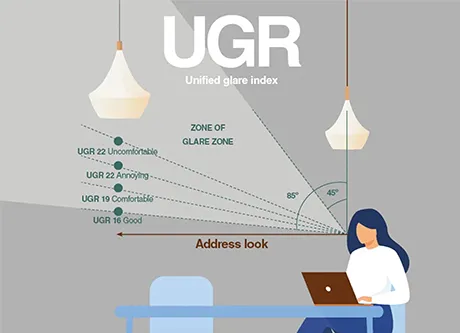
UGR (Unified Glare Rating) and Visual Comfort
UGR quantifies discomfort glare from a luminaire as perceived by an observer. EN 12464-1 specifies maximum UGR values for different task types:
UGR ≤ 16: Precision work (drawing, quality inspection, electronics assembly)
UGR ≤ 19: General industrial work (manufacturing, warehouse picking)
UGR ≤ 22: Rough work (heavy machinery, loading docks)
Linear fixtures inherently offer better glare control than point-source UFO fixtures because their elongated luminous surface reduces peak luminance intensity at any single viewing angle. The Lidu21's innovative optics design further reduces UGR by controlling the luminance distribution across the fixture length, achieving UGR < 19 in most standard configurations.
IP Rating for Environment Protection
Industrial linear fixtures must withstand the environmental conditions of their installation location. Ingress Protection (IP) ratings define protection against solid objects (first digit) and water (second digit):
| IP Rating | Protection Level | Typical Application |
|---|---|---|
| IP20 | No special protection | Clean, dry indoor environments — offices, retail showrooms, clean production areas |
| IP23 | Protected against spraying water & small solid objects | Indoor areas with occasional moisture exposure — sports halls, covered loading bays |
| IP54 | Protected against dust & splashing water | Dusty production floors, warehouse areas with occasional wash-down |
| IP65 | Dust-tight & protected against water jets | Wash-down zones, food processing areas, harsh industrial environments |
The Lidu21 carries an IP23 rating, making it suitable for indoor sports facilities, general production areas, and covered industrial zones where occasional moisture exposure is expected but full wash-down is not required. For environments requiring IP65 protection, Recolux's E-plus tri-proof lights and E-evolution tri-proof lights provide the appropriate protection level.
Flicker-Free Operation
LED flicker — rapid modulation of light output — is an invisible hazard in industrial environments. Low-frequency flicker (below 100 Hz) causes eye strain, headaches, and reduced visual task performance. High-frequency flicker (100–500 Hz) can create stroboscopic effects that make moving machinery appear stationary or slower than actual speed — a serious safety hazard near rotating equipment.
The Lidu21 is specified as flicker-free, meaning its LED driver maintains stable DC output with minimal ripple current (< 1% flicker index). This is essential for:
Production lines with rotating machinery (stroboscopic safety risk)
Quality inspection stations (visual accuracy requirements)
Sports facilities (fast-moving ball tracking by athletes and officials)
Areas with CCTV monitoring (flicker interferes with camera exposure)
Power Switchable and Control Options
Modern industrial lighting must be adaptable to different operating scenarios without requiring hardware replacement. The Lidu21 supports:
Power switchable: Adjustable wattage settings allow the same fixture to be configured for different lux targets — reducing over-lighting in transition zones and saving energy without installing separate fixture models.
ON/OFF control: Basic switching for zones with fixed occupancy patterns.
DALI dimming: Digital Addressable Lighting Interface enables per-fixture addressing, dynamic dimming schedules, daylight harvesting, and integration with building management systems.
Sensor integration: Microwave and PIR occupancy sensors for automatic zone switching — critical for energy savings in intermittently occupied areas.
Bluetooth control: Wireless configuration and commissioning without physical wiring changes — ideal for retrofit projects and phased installations.
Application-Specific Design: Where Linear Fixtures Excel
Production and Assembly Lines
Assembly lines are inherently linear spaces — long, narrow work zones where uniform horizontal and vertical illuminance are critical for task accuracy. Linear fixtures aligned with the production axis deliver:
Consistent illuminance along the full line length (avoiding the "bright center, dark ends" pattern of spaced UFO fixtures)
Reduced shadow depth on work surfaces and component trays
Lower UGR values at the typical viewing angles of seated or standing assembly workers
For production lines requiring 500 lux at the work plane (EN 12464-1 standard for precision manufacturing), a Lidu21 medium-beam configuration at 5 m mounting height achieves the target with a spacing ratio of approximately 1.0× mounting height — meaning fixtures are spaced 5 m apart along the line, each covering a 5×4 m zone.
Sports Halls and Multi-Use Facilities
Sports lighting demands uniform horizontal illuminance across rectangular playing surfaces, minimal glare for athletes tracking fast-moving objects, and flexible control for different activity levels. The Lidu21's selectable beam angles and flicker-free operation make it particularly well-suited for this application.
For a standard basketball court (28×15 m) requiring 300 lux for recreational-level play (EN 12193 Class III), a layout of 12–16 Lidu21 wide-beam fixtures at 6 m mounting height provides uniform coverage with UGR < 22. For competition-level play (Class II, 500 lux), medium-beam configurations at 7–8 m height with DALI dimming allow level switching between training and match modes.
Read more about specialized sports lighting requirements in our Sports Facility LED Lighting Guide.
Warehouse Aisle Lighting
In racked warehouses, the fundamental lighting challenge is vertical illuminance on rack face labels — not horizontal illuminance on the floor. Workers picking product from mid-level rack positions need to read labels and barcodes clearly, and this requires light directed onto vertical surfaces.
Linear fixtures oriented parallel to the aisle axis provide superior vertical illuminance compared to UFO fixtures because their elongated beam pattern naturally distributes light along the rack face plane. A typical 2.5 m wide aisle with 6 m rack height requires:
200 lux horizontal (floor level) for navigation safety
150 lux vertical (rack face, mid-level) for label readability
UGR ≤ 19 at worker viewing angles
A Lidu21 narrow-beam configuration at 8 m ceiling height, oriented along the aisle, delivers both targets with fewer fixtures than a UFO equivalent layout. For detailed warehouse lighting design methodology, see our Warehouse & Logistics Center LED Lighting Guide.
Covered Loading Bays and Canopies
Loading bays present a mixed challenge: they need high horizontal illuminance on the dock floor for safety, vertical illuminance on vehicle rear doors for loading accuracy, and tolerance for occasional moisture exposure from weather exposure at open bay doors. The Lidu21's IP23 rating provides sufficient moisture protection for covered bay areas, and its power-switchable feature allows different light levels for active loading vs. standby periods.
Installation and Maintenance Advantages of Linear Fixtures
Module-Can-Be-Opened Design
One of the most significant maintenance advantages of the Lidu21 is its module-can-be-opened design. In traditional sealed UFO high bays, any component failure — LED module, driver, or optic — typically requires full fixture replacement because the housing cannot be opened without destroying the seal. This creates:
Higher replacement costs (entire fixture vs. individual component)
Longer downtime (ordering and installing a complete unit)
Waste of functional components (a failed driver means disposing of working LEDs)
The Lidu21's openable module design allows targeted component replacement — swap the driver, replace a LED board, or adjust optics — without replacing the entire fixture. In facilities with 200+ linear fixtures, this design approach can reduce 10-year maintenance costs by 40–60% compared to sealed-unit alternatives.
White Housing for Architectural Integration
In sports halls, retail back-areas, and semi-public industrial spaces (visitor corridors, demonstration production lines), fixture appearance matters. The Lidu21's white housing option provides a clean, professional appearance that integrates with architectural ceiling designs — a small detail that matters for facilities that host client visits, auditors, or public events.
Fast Installation with Standard Mounting
Linear fixtures mount on standard ceiling rails, suspension brackets, or surface-mount brackets. Unlike UFO high bays that require rigid hook-mount systems and individual power wiring, linear fixtures can be installed in continuous runs with shared mounting rails and through-wiring connections, reducing installation labor by 30–50% for large-scale projects.
Linear Fixture vs. Trunking System: Understanding the Boundary
A common specification question is whether to use individual linear fixtures or a continuous trunking system. The answer depends on the application's need for continuous-line lighting versus zone-based flexibility:
| Criterion | Linear Fixture (Lidu21) | Trunking System (E-line/N-line) |
|---|---|---|
| Layout flexibility | Individual positioning; easy to reconfigure zones | Continuous line; fixed spacing along trunking rail |
| Best for | Discrete zones, sports halls, mixed-use areas | Long continuous aisles, production lines, high-bay racked warehouses |
| Control granularity | Per-fixture DALI addressing | Per-module addressing along trunking rail |
| Installation type | Surface, suspended, or rail mount | Trunking rail mount (dedicated infrastructure) |
| Future reconfiguration | Easy — move fixtures individually | Moderate — requires trunking rail adjustment |
| IP protection | IP23 (Lidu21) | IP20 (E-line) to IP54 (N-line) |
For facilities that need zone-based flexibility, individual fixture positioning, and IP23 protection, the Lidu21 linear fixture is the correct choice. For long continuous aisles where uniform spacing and integrated mounting infrastructure are preferred, Recolux's E-line trunking system and N-line trunking system provide optimized solutions. Read more in our LED Trunking System Complete Guide.
10-Year Total Cost of Ownership Comparison
The true cost of industrial lighting extends far beyond the purchase price. Energy consumption, maintenance labor, component replacement, and disposal costs over a 10-year operating period determine the real financial impact of a fixture choice.
| Cost Category | 150W LED Linear (Lidu21) | 200W Metal Halide Linear | 150W Sealed UFO LED (non-serviceable) |
|---|---|---|---|
| Initial fixture cost | $85–120 | $60–80 | $70–100 |
| 10-year energy cost (0.12/kWh, 4000h/year) | $720 | $960 | $720 |
| 10-year maintenance (lamp + driver replacement) | $25–40 (module-open design) | $200–300 (lamp + ballast) | $85–120 (full fixture replacement) |
| 10-year disposal / recycling | $5 (targeted component) | $15 (full unit + hazardous MH lamp) | $10 (full sealed unit) |
| 10-year TCO | $830–885 | $1,235–1,355 | $815–950 |
The Lidu21's module-open design creates a TCO advantage over sealed UFO LEDs despite similar energy efficiency, because component-level maintenance eliminates the full-unit replacement costs that sealed designs require. Against legacy metal halide, the advantage is decisive — 33–40% TCO reduction with superior light quality, flicker-free operation, and instant-on capability.
Common Specification Mistakes and How to Avoid Them
Mistake 1: Choosing Beam Angle Based on "Maximum Coverage"
Specifiers often select the widest beam angle available to maximize coverage per fixture and reduce the number of units. This approach creates three problems: over-lighting at eye level (high UGR), under-lighting at the work plane (insufficient lux at task height), and wasted lumens directed outside the useful zone. Always select beam angle based on ceiling height and required illuminance — not maximum coverage.
Mistake 2: Ignoring Flicker Specifications
Many procurement processes evaluate lumen output, efficacy, and IP rating but never check flicker performance. This is a safety-critical oversight near rotating machinery. Require flicker index < 1% or flicker percentage < 8% (at 100 Hz and above) in your specification criteria.
Mistake 3: Specifying Without Control System Planning
Installing 200 linear fixtures with ON/OFF-only control in a facility that operates at different intensity levels throughout the day wastes 30–50% of potential energy savings. Plan the control system (DALI, sensor, Bluetooth) as part of the fixture specification, not as a post-installation add-on.
Mistake 4: Over-Specifying IP Rating
Specifying IP65 for a dry indoor sports hall adds cost, limits fixture options, and provides no operational benefit. Conversely, specifying IP23 for a wash-down zone risks premature failure. Match IP rating to the actual environmental conditions — not to a "higher is better" assumption.
Recolux Lidu21: Product Overview and Specification Summary
The Lidu21 is Recolux's linear industrial fixture designed for production floors, sports facilities, covered loading areas, and low-to-medium height industrial spaces where elongated beam distribution, glare control, and serviceability are priority requirements.
| Parameter | Lidu21 Specification |
|---|---|
| Form factor | Linear industrial fixture |
| Luminous efficacy | Up to 180 lm/W |
| Lumen output range | 9,450 – 22,850 lm (depending on configuration) |
| Beam angle options | Narrow / Medium / Wide (selectable) |
| IP rating | IP23 |
| Flicker performance | Flicker-free (< 1% flicker index) |
| Housing color | White |
| Module design | Can be opened for component-level maintenance |
| Power configuration | Power switchable |
| Control options | ON/OFF | DALI | Sensor | Bluetooth |
| Glare control | Innovative optics, UGR < 19 in standard configurations |
For environments requiring higher IP protection (IP54 or IP65), Recolux offers complementary products in the N-line trunking system (IP54) and E-plus tri-proof (IP65) product lines.
FAQ: Industrial LED Linear Fixture Lighting
Q: When should I choose a linear fixture instead of a UFO high bay?
A: Choose linear fixtures when your space has narrow aisles (≤ 3 m width), low-to-medium ceiling height (3–8 m), elongated work zones (production lines, sports courts), or where glare control (UGR < 19) is a priority. Choose UFO high bays for open production floors at 10+ m ceiling height with symmetric spacing requirements.
Q: What beam angle should I use for a 5 m ceiling warehouse?
A: Medium beam (60°–75°) is optimal for 4–8 m ceiling heights in general warehouse and production areas. It balances horizontal coverage with vertical illuminance on rack faces. Use narrow beam only if your racks are tall (6+ m rack height) relative to the ceiling. Use wide beam for open work zones without racking.
Q: Can linear fixtures and UFO high bays coexist on the same control system?
A: Yes. Both fixture types can operate on the same DALI control bus, allowing per-fixture addressing, zone dimming, and sensor integration. This is the recommended approach for facilities with mixed aisle and open-area zones — use linear fixtures in aisles and UFO high bays in staging areas, all controlled from a single DALI gateway.
Q: Why does flicker-free matter in industrial environments?
A: LED flicker creates stroboscopic effects that make rotating machinery appear to move slower or appear stationary — a serious safety hazard. It also causes eye strain, reduces visual task accuracy, and interferes with CCTV camera performance. Flicker-free operation (< 1% flicker index) eliminates all of these risks.
Q: What is the difference between a linear fixture and a trunking system?
A: A linear fixture (like Lidu21) is an independent, self-contained unit that can be positioned anywhere. A trunking system (like E-line/N-line) integrates multiple LED modules into a continuous rail-mounted line with shared electrical infrastructure. Linear fixtures offer more layout flexibility; trunking systems provide more efficient continuous-line illumination for long aisles.
Q: How much can I save with a module-open design vs. sealed fixtures?
A: Over a 10-year operating period, module-open fixtures like the Lidu21 save 40–60% on maintenance costs compared to sealed UFO LEDs, because component-level replacement (driver, LED board) costs $25–40 versus $85–120 for full sealed-unit replacement. The savings scale with facility size — for 200+ fixtures, the cumulative maintenance cost difference can reach $8,000–16,000 over 10 years.
Conclusion: Making the Right Linear Fixture Decision
Industrial LED linear fixtures are not a niche alternative to UFO high bays — they are the correct choice for a specific set of application conditions that are common across production, warehouse, sports, and covered industrial spaces. When ceiling height is low-to-medium, the space geometry is elongated, glare control is critical, and future maintenance cost matters, linear fixtures deliver better performance per dollar than any round alternative.
The Recolux Lidu21 combines the key advantages — 180 lm/W efficacy, selectable beam angles, flicker-free operation, module-open maintenance, and comprehensive control options (DALI, sensor, Bluetooth) — in a single product designed for the environments where linear geometry is the right answer.
For specific project consultation, layout design, or product specification support, contact the Recolux technical team to discuss your facility requirements and receive a customized lighting proposal.