

LED Lighting for Electronics Manufacturing: A Facility Manager's Guide to High-CRI, ESD-Safe Industrial Lighting
Electronics manufacturing is one of the most lighting-sensitive industries on the planet. A single solder joint inspected under the wrong colour temperature, or a surface-mount pad examined under poor CRI, can turn a finished batch into rework. Yet many electronics facilities still rely on outdated fluorescent battens or generic high bays that were never designed for precision assembly, ESD-controlled zones, or cleanroom-grade particle limits.
This guide is written for facility managers, plant engineers, and procurement teams who need industrial LED lighting that matches the exacting standards of modern electronics production. We will cover illuminance targets, colour quality, glare control, ESD and cleanroom compatibility, and how Recolux industrial luminaires fit each zone of an electronics plant without drifting into IP69 territory.
Why Standard Industrial Lighting Fails in Electronics Plants
General factory lighting is built around one goal: brightness per watt. That is enough in a bulk warehouse or a steel workshop, but it misses the finer requirements of an electronics facility:
Colour discrimination: Resistors, capacitors, wire insulation, and PCBs use subtle colour codes. Low-CRI light hides those differences.
Glare on glossy surfaces: Bare copper, gold-plated pads, and component reels are reflective. A bright point source creates specular glare that hides defects.
ESD risks: Fixtures with poor grounding or plastic housings that generate static can compromise protected areas (EPAs).
Flicker and stroboscopic effects: Conveyor lines and robotic pick-and-place heads can appear to freeze or move backwards under flickering light.
Thermal load: Older lighting adds heat to already temperature-sensitive cleanrooms and SMT lines.
LED technology solves these problems when the specification is written around the task, not just the lumen output.
Lighting Zones in an Electronics Manufacturing Facility
Before choosing fixtures, map the facility by task. Each zone has a different lighting standard, contamination risk, and mounting height.
Surface-Mount Technology (SMT) and Pick-and-Place Lines
SMT lines run at high speed. Operators and automated optical inspection (AOI) systems need uniform, shadow-free light to verify component placement and solder-paste deposits. Recommended targets:
Horizontal illuminance: 500–750 lux at bench height
Uniformity ratio (U0): ≥ 0.7 to avoid dark bands across the conveyor
CRI: Ra ≥ 80 minimum; Ra ≥ 90 for colour-critical inspection
Colour temperature: 4000–5000 K for alertness and colour stability
Flicker: ≤ 5 % flicker percentage, ideally < 1 %
Long continuous runs of Recolux E-line LED trunking work well here. The system offers 20 optical distributions and CRI Ra > 90, which helps operators distinguish between component colours and trace markings without adding task lamps everywhere.
Hand Assembly and Manual Inspection Benches
Hand assembly still dominates rework, final inspection, and high-mix/low-volume production. Inspectors lean over small components for hours. The lighting must be bright but comfortable.
Task illuminance: 750–1000 lux at the work plane
UGR: < 19 to prevent eye fatigue
CRI: Ra ≥ 90 strongly recommended
Mounting height: 2.5–3.5 m above the bench
Diffuse trunking or linear fixtures with a low-glare diffuser reduce the hard reflections that cause inspectors to miss solder bridges or lifted leads.
ESD-Controlled Areas (EPA)
Electrostatic discharge can destroy semiconductors before a human notices. An EPA requires grounded conductive or static-dissipative surfaces, including lighting hardware where possible. Key considerations:
Metal housings with proper earthing are preferred over all-plastic enclosures.
Surface-mounted fixtures should be bonded to the facility earth.
Diffusers should be antistatic or low-charge-generating materials.
Avoid fixtures that create airflow turbulence over sensitive benches.
Aluminium trunking systems such as the E-line and N-line provide a conductive path that can be integrated into the grounding plan, unlike bulk plastic housings.
Cleanrooms and Controlled Environments
Class 100,000 to Class 1000 cleanrooms are common in semiconductor, MEMS, and medical-electronics assembly. Lighting must meet ISO 14644-1 particle limits, so fixtures should be sealed, flush-mounted, and easy to wipe down.
Fixture body: smooth, no exposed screws or crevices where particles collect
IP rating: IP54 minimum for most cleanrooms; IP65 for washdown areas
Materials: powder-coated aluminium or stainless-steel-compatible finishes
Driver location: outside the airflow plenum when possible to reduce heat and particle generation
For sealed cleanroom zones, the Recolux E-evolution or E-plus IP65 tri-proof lines offer smooth housings and extractable designs that simplify maintenance without disturbing the ceiling grid.
Storage, Receiving, and Shipping Areas
These areas do not need colour-critical light, but they do need reliability, motion control, and energy efficiency. Aisle lighting with narrow beam optics helps forklift drivers read labels from a distance.
Horizontal illuminance: 200–300 lux
Controls: occupancy sensors and daylight harvesting where available
Mounting height: 4–8 m depending on racking
The Recolux Lidu21 linear industrial fixture with narrow, medium, and wide beam options can cover wide aisles with fewer rows of luminaires.
Key Specifications for Electronics Manufacturing LED Lighting
Colour Rendering Index (CRI) and TM-30
CRI measures how accurately a light source reveals the colours of objects compared to a reference illuminant. For electronics:
Ra 80–85: Acceptable for general production and warehousing.
Ra 90+: Recommended for inspection, rework, colour-coded wiring, and AOI stations.
TM-30 metrics: Look at Rf (fidelity) and Rg (gamut) when evaluating high-end fixtures. Rf > 90 and Rg between 98 and 105 is a good benchmark for colour-critical work.
The E-line LED control system advertises Ra > 90, which places it in the top tier for industrial LED products and makes it suitable for inspection-heavy electronics environments.
Colour Temperature Selection
Electronics facilities usually benefit from neutral white (4000 K) to cool white (5000 K). Lower colour temperatures (3000 K) can make white solder masks and labels look yellow, while very high temperatures (6500 K) can feel harsh over long shifts. Tunable-white systems are useful in R&D labs where operators need to match end-use lighting conditions.
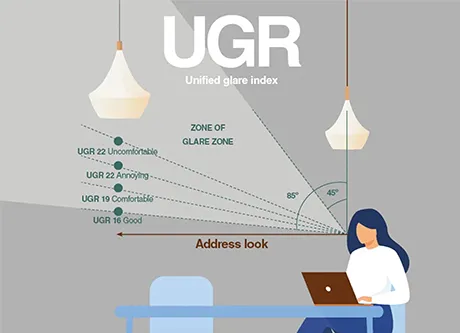
Glare and Unified Glare Rating (UGR)
UGR predicts discomfort glare in indoor spaces. For electronics assembly:
UGR < 16: Ideal for precision inspection and cleanrooms
UGR 16–19: Comfortable for general assembly
UGR 19–22: Acceptable for warehousing and non-precision tasks
Optical systems with micro-prismatic diffusers or bat-wing distributions push light horizontally onto the work plane while keeping the luminous intensity out of the operator's direct line of sight.
Flicker and Temporal Light Artifacts
Flicker is not just a comfort issue in electronics plants. It can interfere with high-speed machine vision and make rotating equipment appear stationary. Specify:
Flicker percentage < 5 % at any dimming level
Stroboscopic visibility measure (SVM) < 1.6, ideally < 1.0
Drivers with high switching frequencies and good ripple suppression
IP and IK Ratings
Electronics facilities span a wide range of environmental conditions. Match the rating to the zone:
| Zone | Suggested IP | Suggested IK |
|---|---|---|
| Cleanroom assembly | IP54 | IK06 |
| SMT production floor | IP40–IP54 | IK06–IK07 |
| Wet process / washdown | IP65 | IK07–IK08 |
| Warehouse / shipping | IP40–IP54 | IK07–IK08 |
Recolux N-line carries IP54 for protected production spaces, while E-plus and E-open reach IP65 for harsher wet or dusty zones. We deliberately cap IP discussion at IP65, because the IP69 requirement belongs to food-grade and specialty washdown environments that are outside the scope of this guide.
Lighting Design Checklist for Electronics Facilities
Use this checklist when planning a retrofit or new-build electronics facility:
Task audit: Document every task type, work-plane height, and inspection standard.
Lux target: Refer to EN 12464-1 or IES RP-7-21 for recommended illuminance levels.
Mounting height: Lower ceilings favour trunking and linear fixtures; higher bays may need high-bay or suspended linear solutions.
Beam angle: Match the optic to the aisle width or bench layout to avoid over-lighting walls.
Controls: Add daylight sensors, occupancy detection, and scheduling to reduce energy and extend driver life.
Maintenance plan: Choose luminaires with extractable LED modules or driver-on-board designs to cut downtime.
Documentation: Keep photometric files, dialux reports, and warranty terms in the project handover pack.
Recolux Product Mapping for Electronics Manufacturing
Here is a practical way to match Recolux industrial luminaires to common electronics-facility zones:
Precision inspection / R&D labs: E-line LED trunking — Ra > 90, multiple optics, low glare.
General SMT and assembly lines: N-line LED trunking — IP54, dust-protected, continuous-run friendly.
Wet process, washdown, and outdoor-adjacent areas: E-evolution, E-plus, or E-open tri-proof lines — IP65, easy maintenance.
High-bay storage and sports/multi-use halls: Lidu21 linear fixture — flexible beam angles, high lumen output.
Office and engineering support areas: Office lighting options for lower illuminance and comfortable UGR.
Common Mistakes When Lighting Electronics Facilities
Over-lighting the Aisles and Under-lighting the Benches
Many facilities install high-bay fixtures at 8–10 m and call the job done. The result is bright aisles and dim benches. Task lighting or lower-mounted linear systems solve this without adding energy.
Ignoring Flicker at Dimming Levels
A fixture may look stable at full power but flicker badly at 20 % dimming. Always check flicker data at the dimming levels you plan to use.
Using Cool White Everywhere
6500 K may seem “cleaner,” but it can cause fatigue and push the blue-light hazard exposure higher. Neutral white (4000 K) is usually the better default for electronics assembly.
Forgetting the Ceiling Load
Cleanroom ceilings have limited point-loading capacity. Heavy, complex fixtures may require extra support. Lightweight aluminium trunking and recessed or surface-mounted linear fixtures are easier to install.
Energy and Maintenance Considerations
LED retrofits in electronics facilities typically cut lighting energy by 50–70 % compared to fluorescent or HID systems. The savings are amplified when controls are added:
Occupancy sensors: Reduce runtime in storage and low-traffic corridors.
Daylight harvesting: Dim perimeter rows near windows during day shifts.
Scheduled shut-off: Ensure lights are off in unoccupied cleanrooms.
Zoned circuits: Keep production, inspection, and storage on separate controls for flexibility.
Maintenance should also be planned. Electronics facilities often run 24/7, so choose luminaires with L80 lifetime ratings of at least 50,000 hours and with replaceable drivers or LED modules. The extractable design of the E-evolution is an example of a maintenance-friendly approach.
Compliance and Standards to Reference
When specifying lighting for an electronics manufacturing facility, reference the following standards:
EN 12464-1: Lighting of indoor workplaces — workplaces with specific visual tasks.
IES RP-7-21: Recommended practice for industrial lighting.
ISO 14644-1: Cleanrooms and associated controlled environments.
ANSI/ESD S20.20: Electrostatic discharge control program requirements.
IEC 62471: Photobiological safety of lamps and lamp systems.
LM-79 / LM-80 / TM-21: LED testing, lumen maintenance, and lifetime projection.
Working with a manufacturer that can provide IES photometric files, LM-79 reports, and a clear warranty makes the specification process much smoother.
Frequently Asked Questions
What CRI is needed for electronics assembly?
For general electronics assembly, Ra ≥ 80 is acceptable. For inspection, rework, and colour-coded tasks, aim for Ra ≥ 90. The Recolux E-line advertises Ra > 90, making it suitable for colour-critical zones.
Can LED lighting cause ESD problems in an EPA?
Any fixture can generate static if it is improperly grounded or made entirely of insulating plastic. Use metal-housed fixtures with proper earthing, and include them in the EPA grounding plan. Avoid fixtures with ungrounded metal parts that operators might touch.
Is IP65 enough for electronics cleanrooms?
IP65 is generally sufficient for cleanrooms with washdown or wet processes. For dry assembly cleanrooms, IP54 is often adequate. The key is sealed, smooth housings that do not shed particles. IP69 is not required for standard electronics manufacturing.
How do I reduce flicker for machine vision systems?
Specify drivers with low flicker percentage (< 5 %, ideally < 1 %) and low SVM. Ask the manufacturer for flicker data at the dimming levels you intend to use. Avoid cheap drivers that rely on simple PWM dimming at low frequencies.
What colour temperature is best for SMT lines?
Neutral white (4000 K) to cool white (5000 K) is the most common choice. It provides good colour discrimination and alertness without the harshness of 6500 K. Avoid warm white (3000 K) because it can distort white and pastel colours on PCBs and components.
Should I use trunking or linear fixtures for electronics assembly?
Trunking systems such as the E-line and N-line are excellent for long production lines because they provide continuous, uniform light with fewer electrical connection points. Linear fixtures like the Lidu21 are better for high-bay storage or areas that need narrower beam control.
Conclusion
Electronics manufacturing demands more from lighting than raw lumens. The right system improves defect detection, reduces eye strain, supports ESD compliance, and cuts energy costs. Focus on high CRI, low glare, low flicker, and the right IP rating for each zone. Match the fixture to the task, and the facility will run safer, cleaner, and more efficiently.
If you are planning an LED retrofit or a new electronics facility, contact Recolux for a lighting layout proposal and product specification tailored to your assembly lines, cleanrooms, and storage areas.