

If you manage lighting for a warehouse, office block, retail unit, or any commercial interior, you have likely encountered the term "LED batten." These slim, linear fixtures have quietly become the default replacement for ageing fluorescent tubes — and for good reason. They consume less power, last far longer, and install in a fraction of the time. But not every batten on the market is built the same, and picking the wrong one can cost you more in maintenance and energy than you ever saved on the purchase price.
This guide walks through everything a facility manager, electrical contractor, or procurement officer needs to know: what an LED batten light is, how it compares with fluorescent alternatives, which specifications actually matter, and how to select the right model for each environment — from dry office corridors to humid production floors.
What Is an LED Batten Light?
An LED batten light is a self-contained linear luminaire that houses LED chips, a driver, and a diffuser within one integrated housing. Unlike retrofit LED tubes that slot into existing fluorescent fittings, a batten replaces the entire fixture — housing, gear tray, and light source together. This integrated design eliminates the compatibility headaches that plague tube retrofits (ballast type mismatches, wiring alterations, and uneven light distribution from mismatched optics).
Modern LED battens typically feature an aluminium or steel body paired with a polycarbonate (PC) or PMMA diffuser. The result is a robust, slim-profile fixture that mounts directly to ceilings or walls via simple clips or brackets. Leading models — such as the Recolux Aluminium Tubes and Steel Tubes series — achieve efficiencies up to 170 lm/W while maintaining flicker-free output and uniform illumination across the full beam angle.

LED Batten vs Fluorescent Tube: Why the Switch Makes Sense
The comparison between LED battens and fluorescent T5/T8 systems is stark. Consider the key differences that affect day-to-day operations and long-term budgets:
Energy Consumption
A typical T8 fluorescent tube system consumes 36–58 W per lamp, plus an additional 6–10 W for the ballast. An equivalent LED batten delivering the same or higher illuminance draws only 15–30 W — a reduction of 40–60%. In a facility running 200 fixtures for 12 hours per day, that gap translates into thousands of euros saved annually on electricity alone.
Lifespan and Maintenance
Fluorescent tubes rated at 10,000–15,000 hours degrade noticeably after 8,000 hours, with output dropping below 70% of initial lux. Quality LED battens deliver 50,000+ hours at L80 (maintaining at least 80% of initial brightness throughout rated life). For a facility operating 4,000 hours per year, that means 12+ years before significant replacement — versus two to three fluorescent re-lamp cycles in the same period. Fewer replacements also mean fewer disruptions to production schedules and lower labour costs for maintenance teams.
Light Quality and Flicker
Fluorescent tubes flicker at 100–120 Hz, a frequency imperceptible to most people but linked to eye strain, headaches, and reduced concentration over extended shifts. LED battens with high-quality drivers — such as those equipped with Osram, Philips, or Tridonic components — operate flicker-free, providing steady illumination that supports visual comfort and task accuracy. This is particularly important in inspection areas, packaging lines, and office environments where prolonged visual focus is required.
Instant Start and No Warm-Up
Fluorescent lamps, particularly in cold environments, require several seconds to reach full brightness. LED battens illuminate at 100% output from the first second, making them ideal for spaces where lights are switched frequently — corridors, storerooms, and areas with motion-sensor control. Instant restrike also improves safety in emergency scenarios where lighting must restore without delay.

Key Specifications That Actually Matter
Product datasheets list dozens of parameters, but a handful determine whether a batten will perform well in your specific environment. Focus on these before comparing anything else:
Luminous Efficacy (lm/W)
Efficacy tells you how much light you get per watt of electricity consumed. Budget battens cluster around 120–140 lm/W; premium models reach 160–170 lm/W. At first glance the difference may seem modest, but over hundreds of fixtures running thousands of hours, a 20 lm/W gap compounds into real energy cost divergence. The Recolux Aluminium Tubes series delivers up to 170 lm/W, placing it among the most efficient battens available for commercial interiors.
Colour Temperature (CCT) Selectability
Different tasks and spaces demand different colour temperatures. Offices typically require 4000 K (neutral white) for alertness and visual clarity; retail display areas may prefer 3000 K (warm white) for ambience; industrial inspection zones benefit from 5000–6500 K (cool white) for detail discrimination. Rather than ordering separate fixtures for each zone, CCT-selectable battens let you set the desired temperature on-site via an onboard switch. Recolux battens across the Aluminium Tubes, Steel Tubes, and Allnice ranges all offer CCT selectability — one SKU covers multiple application zones, simplifying procurement and inventory management.
Power Switchability (Multilumen Output)
Power-switchable battens provide multiple wattage settings on a single fixture — for example, 15 W / 20 W / 25 W selectable via a simple toggle. This feature serves two purposes. First, it allows fine-tuning of illuminance to match the actual lux requirement of each space without over-lighting (which wastes energy and creates glare). Second, it means one product model can serve different areas with varying height or usage patterns, again reducing SKU complexity. The Recolux Steel Tubes and Aluminium Tubes both offer power switchable configurations.
UGR (Unified Glare Rating)
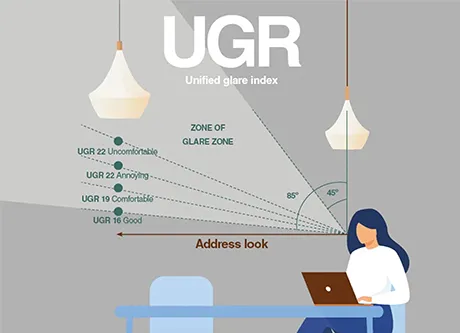
In office and educational environments, glare control is a regulatory and comfort requirement. EN 12464-1 specifies UGR limits for different task types — UGR < 19 for general office work, UGR < 16 for demanding visual tasks such as technical drawing. Standard battens with clear diffusers or narrow beam optics may exceed these thresholds. The Recolux Allnice series specifically addresses glare with a low UGR solution and a 130° beam angle that distributes light broadly without creating hot spots, making it suitable for office ceilings and retail back-of-house areas.
IP Rating and Environmental Protection
IP (Ingress Protection) ratings define a fixture's resistance to dust and water. For LED battens, the three most relevant tiers are:
IP20 — No special protection against moisture. Suitable for dry, clean interiors such as offices, meeting rooms, and retail display floors.
IP44 — Protected against solid objects greater than 1 mm and splashing water. The Recolux Allnice batten carries IP44, making it appropriate for environments where occasional moisture or dust is present — covered car parks, utility rooms, and light industrial areas.
IP65 — Dust-tight and protected against water jets. When the environment involves regular wash-downs, high humidity, or airborne particulates, IP65 tri-proof luminaires such as the Recolux E-evolution and E-plus are the correct choice rather than a standard batten.
Choosing an IP rating higher than needed adds cost and limits diffuser optical performance; choosing too low risks premature failure. Match the rating to the actual conditions, not to a "higher is always better" assumption.

Choosing the Right LED Batten for Each Environment
Batten selection depends on the physical conditions of the space and the visual tasks performed there. Here is a practical framework covering the most common commercial and industrial settings:
Offices and Meeting Rooms
Requirements: UGR < 19, flicker-free, CCT 4000 K, even illumination with no shadow pooling. The Recolux Allnice batten is designed for exactly this profile — its low UGR optics, slim steel+PMMA body, and CCT/power switchability let facility teams standardise on one fixture across open-plan desks, conference rooms, and reception areas. The smart end-cap design also reduces installation time, which matters when deploying hundreds of units across a multi-floor building.
Retail and Commercial Display
Requirements: High CRI (>90 where merchandise colour fidelity matters), flexible CCT to match brand ambience, even aisle illumination for safety and product visibility. Aluminium Tubes battens with optional high-CRI LED packages and CCT selectability adapt from cool-white grocery aisles to warm-white fashion displays. Their flicker-free output also prevents the stroboscopic effect that distorts perceived product colours under fluorescent lighting.
Industrial Production and Assembly Areas
Requirements: High efficacy for cost control in large volumes, robust construction, power switchability to match varying ceiling heights and task difficulty, optional sensor integration for energy management in intermittently occupied zones. Steel Tubes battens, with their steel body + PC cover construction, withstand the knocks and vibration typical of production floors. Power switchability (15/20/25 W or similar) lets you dial illuminance to the EN 12464-1 minimum for each task type without overshooting. Optional microwave or PIR sensors turn lights off in vacant zones — a feature that can cut lighting energy by an additional 30–50% in areas with irregular occupancy patterns.
Warehouses and Logistics
Requirements: Bright, uniform aisle lighting for safety and pick accuracy; high efficacy for long operating hours; compatibility with trunking systems for continuous-line installations. In many warehouses, LED battens mounted individually on ceiling grids serve lower-bay aisles (3–5 m height). For high-bay racking (>8 m), high-bay luminaires are the appropriate choice. Batten fixtures shine in the medium-height zones where their wide beam angles provide even coverage without hot-spot glare at floor level. Recolux battens integrate with the E-line trunking system for continuous-line applications where seamless, linked illumination across long aisles is required — a configuration discussed in detail in the LED Trunking System Guide.
Underground Garages and Covered Parking
Requirements: IP44 minimum (concrete dust and vehicle-splash), CCT 4000 K or 5000 K for visibility, sensor compatibility for energy management in 24/7-access spaces with intermittent occupancy. The Recolux Allnice IP44 batten, paired with an integrated microwave sensor, provides a robust solution for covered parking. Its 130° beam angle eliminates dark corners between parked vehicles, and sensor-driven dimming reduces power to 10–20% standby when the zone is vacant — cutting annual lighting energy by up to 70% compared with always-on fluorescent installations.
Installation: Why Design Details Save Real Money
Installation labour is a hidden cost in lighting projects. A fixture that saves €5 per unit on purchase price but takes 15 minutes longer to mount will cost more in total when deploying 200+ units. Modern LED battens address this with thoughtful mechanical design:
Fast-Clip and End-Cap Mechanisms
The Recolux Allnice batten features a smart end-cap design that opens and closes without tools, allowing the electrician to wire the terminal block and snap the cap back in seconds. Similarly, the Aluminium Tubes and Steel Tubes battens use clip-on brackets and push-fit end caps that eliminate screw-driven mounting. In benchmark installations, these features reduce per-fixture mounting time by 60–80% compared with conventional battens requiring screws at every fixing point.
Mid-Point AC Input with 5-Pin Terminal
The Allnice's AC input positioned at the fixture midpoint with a 5-pin terminal simplifies through-wiring. Instead of routing supply cables to one end and looping from fixture to fixture, the mid-point input creates a natural splice point for daisy-chain connections — reducing cable length and junction complexity in long linear runs.
Through-Wiring for Continuous Runs
Alluminium Tubes and Steel Tubes battens support internal through-wiring, where the supply cable passes through the fixture body to the next unit without external junction boxes. This creates clean, continuous ceiling runs that are both faster to install and visually tidier — an advantage in exposed-ceiling offices and retail spaces where the lighting hardware is part of the interior aesthetic.
Emergency and Sensor Options: Building Resilience into the Lighting Plan
Commercial buildings increasingly require emergency lighting compliance and smart energy management. LED battens that accommodate these options within the same housing avoid the cost and clutter of add-on boxes.
Integrated Emergency Backup
Select Recolux batten models offer built-in emergency battery packs (typically 1–3 hour duration) that maintain minimum illuminance during power failure. This is essential for escape-route compliance under EN 1838 and for operational continuity in critical zones such as server rooms, control rooms, and production lines where sudden darkness creates safety hazards.
Sensor Integration
Microwave and PIR sensors can be factory-fitted or field-installed into compatible batten housings. Microwave sensors detect motion through thin walls and glass — useful in partitioned offices and storerooms where line-of-sight PIR sensors fail. Sensor-driven battens switch to full output when a person enters the zone and dim to a low standby level (10–20%) when the zone is vacant. In facilities with variable occupancy — meeting rooms, break areas, warehouse aisles — this cuts energy consumption by 30–50% beyond the baseline LED savings.
Total Cost of Ownership: Batten vs Fluorescent Over 10 Years
Purchase price is only one line in the cost ledger. A realistic comparison must account for energy, maintenance, disposal, and compliance over the fixture's full operational life. The table below models a 200-fixture installation running 4,000 hours per year:
| Cost Item | Fluorescent T8 (2×36 W) | LED Batten (Recolux, 20 W selectable) |
|---|---|---|
| Initial fixture cost (200 units) | €4,000 | €8,000 |
| Annual energy cost (€0.12/kWh) | €7,200 | €1,920 |
| Replacement lamps (3 cycles in 10 yrs) | €3,600 | €0 |
| Replacement labour (3 cycles) | €4,000 | €0 |
| Disposal / recycling (fluorescent mercury) | €800 | €0 |
| 10-Year Total | €83,600 | €27,200 |
| 10-Year Saving with LED Batten | €56,400 |
Even with a higher initial purchase price, the LED batten system saves over €56,000 across a decade — a return that validates the upgrade within 1.5 to 2 years. Add sensor-driven dimming, and the payback period compresses further.
Common Mistakes to Avoid When Specifying LED Battens
After hundreds of batten installations across industrial and commercial projects, several specification errors recur:
Over-specifying IP rating. Installing IP65 battens in a dry office wastes money and often sacrifices optical quality (thicker diffusers for weatherproofing reduce clarity). Use IP20/IP44 for dry interiors; reserve IP65 for genuinely wet or dusty environments.
Ignoring UGR in office environments. Selecting a batten with good efficacy but poor glare control violates EN 12464-1 and creates visual discomfort that undermines productivity. Always verify UGR compliance for task-oriented spaces.
Choosing fixed-wattage fixtures for variable-height spaces. A fixed 25 W batten over-lights a 3 m corridor and under-lights a 5 m production bay. Power-switchable models allow per-zone tuning with a single SKU.
Skipping the driver quality check. Cheap drivers produce flicker, early failure, and incompatible dimming curves. Specify drivers from established brands (Osram, Philips, Tridonic) and demand 5–7 year warranties — as standard on Recolux Aluminium and Steel Tubes battens.
Neglecting emergency and sensor provisions at specification stage. Adding emergency packs or sensors after installation requires housings to be opened, re-wired, and re-sealed — often at greater cost and with compromised weatherproofing. Specify these options upfront.
Recolux LED Batten Product Lines at a Glance
Recolux offers three distinct batten ranges, each tailored to specific application priorities:
Allnice (Steel + PMMA, IP44)
The Allnice is Recolux's interior-focused batten, designed for offices, retail back-of-house, covered parking, and light industrial spaces where occasional moisture exposure is possible but not constant. Key features include a low UGR solution for glare-sensitive environments, CCT and power selectability, a smart end-cap for rapid installation, and mid-point AC input with 5-pin terminal for efficient through-wiring. Its slim white profile integrates cleanly into exposed-ceiling and surface-mount installations.
Aluminium Tubes (Aluminium + PC Cover)
The Aluminium Tubes series prioritises thermal performance and optical clarity. The aluminium body provides superior heat dissipation, extending LED and driver life — a critical factor in environments where fixtures operate 12+ hours daily. With efficacy up to 170 lm/W, CCT and power selectability, optional sensor/emergency integration, and halogen-free wire options for compliance in public buildings, this range serves industrial production areas, retail aisles, and commercial interiors that demand high output and long service intervals.
Steel Tubes (Steel + PC Cover)
Steel Tubes battens share the same performance platform as Aluminium Tubes (170 lm/W, CCT/power selectable, flicker-free, Osram/Philips/Tridonic drivers) but substitute a steel housing for applications where mechanical robustness matters more than thermal dissipation — production floors subject to vibration and incidental contact, storage areas with heavy-goods traffic, and utility spaces where fixture durability is the primary concern.
When to Choose a Batten vs a Tri-Proof Luminaire
LED battens and tri-proof luminaires both deliver linear LED illumination, but they serve different environmental tiers. The decision boundary is straightforward:
Dry interiors with no wash-down requirement — LED batten (IP20/IP44). Lower cost, wider diffuser optical options, slimmer profile.
Environments with regular moisture, dust, or chemical exposure — IP65 tri-proof luminaire such as E-evolution (extractable design for easy maintenance) or E-plus (L1/L2/L3 phase-change for grouped dimming control). Sealed housings, corrosion-resistant materials, and continuous gasketing protect the LED module and driver from ingress that would destroy a standard batten within months.
Extreme wash-down environments (food processing, agriculture) — Tri-proof luminaires with IP65 rating and chemical-resistant housings. Note: Recolux's product range supports IP65 as the highest standard protection tier for tri-proof applications.
For a deeper comparison of IP tiers and what each rating actually protects against, refer to the LED Tri-Proof Lights: What They Protect Against guide on the Recolux blog.
FAQ
Can I replace fluorescent tubes with LED battens without changing the wiring?
In most cases, yes. LED battens connect directly to the existing mains supply. The fluorescent ballast and starter are bypassed or removed — the batten's integrated driver handles power conversion internally. A qualified electrician can complete the swap in under five minutes per fixture using the clip-mount and through-wiring features found on modern battens.
What CCT should I choose for a mixed-use building?
For buildings with both office and industrial zones, CCT-selectable battens (3000 K / 4000 K / 5000 K) allow you to tune each zone independently from a single product SKU. Set 4000 K for general office and circulation areas, 5000 K for inspection and assembly tasks, and 3000 K for reception and break rooms.
Do LED battens work with DALI dimming systems?
Select models equipped with DALI-compatible drivers support 0–100% dimming via standard DALI protocols. This is essential for projects integrating lighting into building management systems (BMS) or implementing daylight-harvesting strategies where illuminance adjusts dynamically to available natural light.
How long does a quality LED batten actually last?
Premium LED battens with established-brand drivers are rated at 50,000 hours (L80/B50) — meaning at least 80% of initial output is maintained for 50% of the population at 50,000 operating hours. At 4,000 hours per year, that exceeds 12 years of service. Recolux Aluminium Tubes and Steel Tubes battens carry 5–7 year warranties as standard, reflecting confidence in driver and LED module longevity.
Is an IP44 batten sufficient for a covered car park?
Yes, in most covered car parks where the fixture is mounted under a solid ceiling and exposed only to vehicle-related splash and concrete dust. IP44 protects against splashing water and objects >1 mm. For open-sided car parks exposed to rain, move to IP65 tri-proof luminaires.
What is the difference between power switchable and dimmable?
Power switchable means the fixture offers discrete wattage settings (e.g., 15 W / 20 W / 25 W) selected via a physical switch on the housing — set once during installation. Dimmable means the output adjusts continuously via a control signal (DALI, 1–10 V, or wireless) — changing dynamically during operation. Power switching addresses static design needs; dimming addresses dynamic operational needs.
Conclusion: Making the Right Batten Decision
LED batten lights have become the backbone of commercial and industrial interior lighting because they combine efficiency, longevity, and installation simplicity in one integrated package. The key to a successful specification is matching the fixture to the environment — IP44 for dry to mildly moist interiors, IP65 tri-proof for wet and dusty conditions — and selecting features that reduce total cost rather than just purchase price. CCT and power selectability, low UGR optics, factory-fitted sensors and emergency packs, and fast-install mechanical design all contribute to a lower 10-year TCO.
Recolux's batten portfolio — Allnice for glare-sensitive interiors, Aluminium Tubes for high-output thermal-demanding spaces, and Steel Tubes for mechanically rugged environments — covers the full spectrum of commercial and industrial interior requirements with a unified platform of selectability, flicker-free output, and 5–7 year warranty backing.
To discuss your project requirements or request a custom lighting layout calculation, contact the Recolux team directly.