

Low Bay Industrial LED Lighting: The Complete Guide for Facilities Under 20 Feet (2026)
The loading bay at a distribution center outside Chicago had a problem that showed up every November: the 400 W metal halide fixtures mounted at 14 feet took five minutes to restart after a power blink, and the forklift drivers were sitting in the dark during those five minutes. In a facility moving 40 pallets an hour, that downtime added up. Low bay industrial LED lighting would have solved it — instant-on, no restrike delay, half the wattage — but nobody had looked at the ceiling height and realized that these were low bay spaces, not high bay, and the fixture choices should have been different from day one.
Low bay lighting is a category that gets lumped in with general industrial lighting, but the design considerations are distinct. Ceiling height changes everything: beam angles, fixture spacing, glare control, even which product families make sense. This guide covers what you need to know when specifying LED lighting for industrial spaces with ceilings under 20 feet (6 meters).
What Is Low Bay Lighting (and When Does It Matter)
Ceiling Height Thresholds
The lighting industry generally draws the line between low bay and high bay at 20 feet (6 meters). Here is how it breaks down:
Low bay: Ceilings from 8 to 20 feet (2.5–6 m)
High bay: Ceilings from 20 to 45 feet (6–14 m)
Some sources use 15 feet as the low bay cutoff, but the 20-foot threshold is more widely accepted in IESNA and CIBSE guidelines. What matters more than the exact number is how the ceiling height interacts with the fixture’s beam angle and lumen output. At 14 feet, a 150 W high bay fixture with a narrow 60° beam creates hot spots and dark zones. At 35 feet, a 50 W low bay batten with a wide 120° spread leaves the floor dim. The fixture must match the space.
Common Low Bay Environments
Low bay spaces show up more often than people think:
Warehouse aisles with racking up to 16 feet
Manufacturing workshops and small assembly halls
Parking garages (ceilings typically 8–12 feet)
Retail back-of-house and stockrooms
Cold storage anterooms
Underground utility tunnels and maintenance corridors
Food processing areas with dropped ceilings for hygiene
In all of these, the lighting design challenge is the same: deliver enough light to the work plane without creating glare at eye level, which in a low bay space is uncomfortably close to the fixture.
Low Bay vs High Bay: More Than Just Height
Understanding the difference between low bay and high bay lighting is not academic — it determines which fixtures you should buy and how you should lay them out.
Beam Angle and Light Distribution Differences
High bay fixtures typically use narrow beam angles (60°–90°) to push light down from 30+ feet without wasting it on the walls. Low bay fixtures need wide beam angles (100°–120°) because the light source is closer to the work plane. A narrow beam at 14 feet creates a bright spot directly under the fixture and leaves the surrounding area underlit.
Wide distribution is the reason linear fixtures — trunking systems, battens, and linear LED modules — dominate low bay applications. Their elongated form factor spreads light along the length of an aisle rather than punching a bright circle into the floor.
Wattage and Lumen Output Ranges
Low bay spaces need less output per fixture because the light has a shorter distance to travel. General guidelines:
| Ceiling Height | Recommended Lumens per Fixture | Typical Wattage |
|---|---|---|
| 8–10 ft | 2,000–4,000 lm | 15–30 W |
| 10–15 ft | 4,000–8,000 lm | 30–60 W |
| 15–20 ft | 8,000–15,000 lm | 60–100 W |
Compare this to high bay fixtures, which range from 15,000 to 60,000 lumens and 100–500 W. Over-specifying wattage in a low bay space wastes money on both the fixtures and the energy to run them.
Fixture Type Selection Logic
In high bay spaces, round UFO fixtures and pendant-mounted HID replacements are standard. In low bay spaces, the geometry favors linear and rectangular fixtures:
Trunking systemsfor continuous-run aisles
LED battens for individual bay lighting
Tri-proof lights for harsh environments
Tubular lights for wet or washdown areas
High bay fixtures in a low bay space are not just inefficient — they are often the wrong form factor entirely. A 150 W UFO high bay at 12 feet is like using a floodlight to read a book.
Best LED Fixture Types for Low Bay Spaces
Trunking Systems (E-line, N-line)
Trunking systems are the backbone of low bay warehouse lighting. A trunking rail carries both the electrical bus and the mounting hardware, and LED modules (called “inserts” or “luminaires”) click into the rail at whatever spacing the layout requires.
For low bay applications, the Recolux E-line trunking system offers 20 optical system combinations, which means you can fine-tune the beam pattern for aisle width, racking height, and ceiling clearance without changing the fixture housing. CRI >90 across the range makes it suitable for quality control areas and retail stockrooms where color accuracy matters.
The N-line variant adds IP54 protection — dust-proof and splash-resistant — for low bay spaces in harsher environments: loading docks exposed to weather, grain storage facilities, or workshops with airborne particulates.
Why trunking works in low bay:
Continuous run wiring: Power enters at one point and feeds the entire rail. No home runs to every fixture.
Tool-less module replacement: Snap out a failed insert, snap in a new one. No electrician needed for the swap.
Optical flexibility: Different inserts for different aisle widths, all on the same rail. You can even mix optics within a single run.
LED Batten Lights
LED battens are standalone linear fixtures — simple, reliable, and quick to install. They are the workhorse of low bay lighting for spaces that do not need the configurability of a trunking system.
The Recolux Allnice LED batten is designed specifically for fast installation. The end-cap clip system eliminates screws and reduces installation labor by roughly 80 % compared to conventional battens. At IP44, it handles dry and mildly damp indoor spaces: workshops, storage rooms, corridors, and office-adjacent areas.
The Tubes LED batten series adds an aluminum alloy and PC housing for better heat dissipation and durability, available in multiple lumen packages and color temperatures. If you are outfitting a warehouse with varying task requirements, the ability to specify different CCT and lumen outputs within the same fixture family simplifies procurement.
Tri-Proof Lights for Harsh Low Bay Environments
Low bay spaces in food processing, chemical plants, and outdoor workshops need more than a basic batten. Tri-proof lights — sealed against water, dust, and corrosion — are the answer.
E-evolution: The flagship tri-proof for demanding low bay applications. PC housing with an internal aluminum heat sink, CCT switching (3000/4000/6500 K), optional emergency backup, and sensor compatibility. The stand-out feature for maintenance-heavy facilities: a slide-out core design. The LED module and driver pull out of the housing without removing the fixture from the ceiling. In a low bay space where the fixture is 12 feet up and you are working off a step ladder, that design choice turns a 30-minute job into a 5-minute one.
E-plus: Adds L1/L2/L3 phase switching, which lets you wire groups of fixtures on separate circuits and control them independently. In a low bay workshop running two shifts — full brightness on day shift, 50 % on night shift — the phase switching handles it without a separate control system or dimming driver. The 5×2.5 mm² cable specification also makes for more durable connections in environments where vibration and thermal cycling are constant.
E-open: Built for retrofits. If you are pulling out old fluorescent fixtures in a low bay space and want to minimize downtime, E-open’s open end caps and tool-free wiring let you swap a fixture in under five minutes. The design philosophy is straightforward: get the old one down, get the new one up, move on.
Tubular Lights for Wet and Dusty Areas
When the low bay space involves water — underground parking, washdown bays, outdoor loading areas — tubular lights deliver the highest protection level available.
Recolux’s Tubular Light series carries an IP69K rating, which means it withstands close-range, high-pressure, high-temperature water jets. No other IP rating goes higher for water ingress protection. Available with PC, PMMA, or glass lampshades, all three versions support surface mount or suspended installation with through-wiring.
For a parking garage with 10-foot ceilings where salt, moisture, and vehicle exhaust are daily realities, IP69K tubular lights are not overkill — they are the correct specification.
Designing a Low Bay Lighting Layout
Spacing and Uniformity Ratios
In a low bay space, uniformity matters more than peak illuminance. A bright spot under each fixture surrounded by dark zones forces the eye to constantly readjust, which creates fatigue and increases error rates.
Target uniformity ratios:
General warehouse: Max:Min ratio of 3:1 or better
Manufacturing: Max:Min ratio of 2:1 or better
Inspection areas: Max:Min ratio of 1.5:1 or better
Spacing-to-mounting-height ratio (SHR) is the quick calculation for layout:
For trunking systems with wide optics: SHR of 1.5–1.75
For LED battens with 120° beam: SHR of 1.2–1.5
For tri-proof lights in continuous runs: SHR of 1.5–2.0
Example: At a 14-foot mounting height with a 120° batten, spacing fixtures at 17–21 feet apart will typically achieve 3:1 uniformity. A photometric calculation (Recolux provides these as part of the spec process) will confirm the exact numbers for your space.
Task-Area vs Ambient Lighting
Not every square foot of a low bay space needs the same light level. Aisle lighting can run at 150 lux; the picking station at the end of the aisle needs 300 lux. Rather than over-lighting the entire space, use a two-tier approach:
Ambient layer: Trunking system or battens at standard spacing, delivering base-level illumination
Task layer: Higher-output inserts or directional optics at workstations, bumped to target lux levels
This approach saves energy and reduces the total number of fixtures. It also means you are not blasting 500 lux into an empty aisle.
Wall-Mounted vs Ceiling-Mounted Options
In some low bay spaces — parking garages, tunnels, narrow corridors — ceiling mounting is impractical or the ceiling does not exist. Wall-mounted tri-proof lights or tubular lights can provide both general illumination and directional guidance.
For wall mounting at 8–10 feet in a parking garage, angle the fixture downward at 15–20° and space them at 1.5× the mounting height along the wall. This creates a wash of light across the driving lane without shining directly into drivers’ eyes.
Key Specifications for Low Bay Industrial LED Lighting
Lumen Packages for Different Ceiling Heights
Do not guess. Use the IESNA recommended illuminance levels for your space type and work backward from the mounting height to determine the lumen package.
Quick reference for low bay:
| Space Type | Target Lux | Ceiling 10 ft | Ceiling 14 ft | Ceiling 18 ft |
|---|---|---|---|---|
| Storage | 150 | 2,500 lm | 3,500 lm | 5,000 lm |
| General workshop | 300 | 4,500 lm | 6,000 lm | 9,000 lm |
| Inspection | 500 | 7,500 lm | 10,000 lm | 14,000 lm |
These are per-fixture numbers assuming standard spacing. Actual values depend on room reflectances, fixture spacing, and any obstructions (racking, ductwork, etc.).
Beam Angle Selection (Wide vs Narrow)
Low bay = wide beam. That is the rule. Exceptions:
Aisle lighting with tall racking: A slightly narrower optic (90°–100°) can put more light between the racks rather than lighting the top of the racking
Wall-wash applications: Asymmetric optics that push light toward the wall rather than straight down
Accent or task spots: A narrow beam for a specific work area within a larger low bay space
The E-line trunking system’s 20 optical options exist precisely for these variations. You can run wide optics in the main aisle and narrower ones at the picking face, all on the same trunking rail.
Color Temperature for Low Bay Tasks
The same principles apply as in general industrial lighting, but low bay spaces often involve closer visual work:
4000 K for general low bay spaces (warehouses, garages, corridors)
5000 K for workshops and assembly areas where visual acuity matters
3000 K for break rooms, offices, and transition zones
Avoid 6500 K in low bay spaces. The fixtures are close enough to eye level that cool daylight temperatures create harsh, uncomfortable glare, especially on reflective floors.
Emergency and Sensor Options
Low bay spaces in warehouses and parking structures often require emergency lighting for safe egress. Two approaches:
Integrated emergency drivers: Built into the fixture, kicks in automatically during a power outage, delivers 10–25 % of normal output for 1–3 hours. Available on E-evolution tri-proof lights and most Recolux trunking inserts.
Separate emergency battens: Standalone fixtures with their own battery, mounted alongside the normal lighting. Simpler to specify but adds another fixture type to maintain.
Sensors (microwave or PIR) are a cost-effective addition for low bay spaces with variable occupancy — parking garages, storage rooms, workshop perimeters. The fixture dims to 20–30 % when the area is empty and returns to full brightness on motion detection. Energy savings in intermittently used low bay spaces can reach 40–60 %.
Installation Tips and Common Mistakes
Avoiding Glare at Eye Level
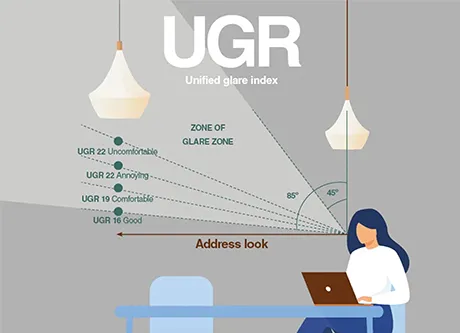
In a high bay space, the fixture is 30+ feet up and glare is manageable. In a low bay space at 12 feet, a bare LED array at eye level is a legitimate safety hazard — it can temporarily blind forklift operators and create reflection issues on work surfaces.
Mitigation strategies:
Use frosted or opal diffusers instead of clear lenses
Choose fixtures with UGR (Unified Glare Rating) below 22 for office-adjacent areas, below 19 for sustained visual tasks
Angle wall-mounted fixtures slightly downward to keep the light source out of the direct line of sight
The E-line trunking system’s glare control is engineered for this — it is one of the reasons trunking works well in low bay retail and commercial applications
Cable Routing in Low Bay Spaces
Low bay spaces often have limited ceiling cavity depth for cable runs. Trunking systems solve this elegantly: the trunking rail itself carries the bus, and the cables run inside the rail profile. No separate conduit, no cable trays eating into the already-tight clearance above the fixtures.
For standalone battens and tri-proof lights, use through-wiring wherever possible. Feed power in at one end, pass it through to the next fixture, and daisy-chain the run. This reduces the number of circuit homeruns back to the distribution panel.
Retrofit vs New Installation
If the existing lighting is fluorescent or HID and the fixtures are in reasonable condition, a tube-for-tube LED swap or a batten-for-batten replacement is the fastest path. Budget roughly 15–30 minutes per fixture for a swap with no wiring changes.
If the existing system is outdated, unreliable, or the layout no longer matches the space use, a full trunking system installation is the better long-term investment. It costs more upfront but delivers a lighting system that can be reconfigured, expanded, or upgraded without replacing the infrastructure.
A medium-sized workshop in Michigan made this decision in 2025. The original plan was to swap 200 fluorescent battens for LED battens — a 28,000projectwitha2.5−yearpayback.Afterasitesurvey,theyswitchedtoanE−linetrunkingsystemat42,000 but with a 2.1-year payback (better optics meant fewer fixtures needed) and the ability to reconfigure the lighting layout when they reorganize the shop floor, which they plan to do annually.
Low Bay Industrial LED Lighting Costs and Energy Savings
Energy Comparison
| Fixture Type | Watts | Lumens | Efficacy | Annual Energy (24/7) | Annual Cost ($0.10/kWh) |
|---|---|---|---|---|---|
| 2× fluorescent T8 batten | 74 W | 5,600 lm | 76 lm/W | 648 kWh | $64.80 |
| LED batten (Recolux Allnice) | 30 W | 4,200 lm | 140 lm/W | 263 kWh | $26.30 |
| E-line trunking insert | 40 W | 5,800 lm | 145 lm/W | 350 kWh | $35.00 |
For a 100-fixture low bay space, switching from fluorescent to LED battens saves approximately $3,850 per year in energy costs alone. Add maintenance savings (no tube replacements, no ballast failures) and the total cost of ownership gap widens further.
Rebate Availability
Low bay LED retrofits qualify for the same utility rebate programs as other commercial LED upgrades. Typical rebates:
5–15 per LED tube or batten
20–75 per trunking system insert
30–100 per tri-proof fixture
Check with your local utility before purchasing — some programs require pre-approval and specific efficiency thresholds (e.g., minimum 130 lm/W, DLC listing).
Recolux Low Bay Lighting Solutions
Recolux designs and manufactures a full range of LED fixtures built for the realities of low bay industrial spaces — not just rebranded high bay fixtures with lower wattage.
For low bay warehouses and logistics centers: The E-line trunking system offers the optical flexibility and continuous-run wiring that makes aisle lighting efficient to install and maintain. N-line adds IP54 for dusty or splash-exposed environments.
For workshops and manufacturing bays: Allnice and Tubes LED battens provide quick-install, reliable illumination. For harsher environments, the E-evolution tri-proof light’s removable core design keeps maintenance time low even when fixtures are hard to access.
For parking structures and wet areas: The IP69K tubular light range handles the worst conditions — high-pressure washdown, salt exposure, constant moisture — without compromising on light output or longevity.
For phased upgrades: E-open tri-proof lights are designed around retrofit speed. Open end caps, tool-free wiring, and a housing that covers the footprint of most legacy fluorescent fixtures.
All Recolux low bay products support OEM and ODM customization. If your project requires non-standard lengths, custom CCT values, or specialized optics, Recolux engineers work from the specification through to production.
Frequently Asked Questions
What ceiling height counts as “low bay”?
The standard threshold is 20 feet (6 meters). Spaces with ceilings between 8 and 20 feet are low bay; above 20 feet is high bay. The distinction matters because it determines beam angles, fixture types, and lumen packages.
Can I use high bay fixtures in a low bay space?
Technically yes, but it is usually a bad idea. High bay fixtures have narrow beam angles and high lumen outputs that create hot spots and glare at low mounting heights. They also cost more and consume more energy than properly specified low bay fixtures.
Do low bay LED lights need special drivers?
Most low bay LED fixtures use integrated drivers rated for 120–277 V input. For facilities with 480 V distribution, step-down transformers or 480 V-rated drivers are available. Always verify the input voltage range on the spec sheet before ordering.
How many low bay fixtures do I need per square foot?
It depends on the target lux level, ceiling height, and fixture output. As a rough starting point for a 14-foot ceiling with LED battens at 4,000 lumens: one fixture per 80–120 sq ft for general storage (150 lux), one per 40–60 sq ft for workshop areas (300 lux). A photometric layout will give you the exact number.
Are tri-proof lights worth the extra cost in a low bay space?
If the environment involves water, dust, or chemical exposure, yes. The sealed housing extends the fixture’s lifespan and reduces cleaning and maintenance frequency. In a dry storage room, a standard LED batten is sufficient and more cost-effective.
Next Steps
Low bay industrial LED lighting is not just “high bay lighting at lower wattage.” The ceiling height changes the beam angle, the fixture form factor, the glare strategy, and the layout math. Getting it right means fewer fixtures, less energy, and a more comfortable work environment. Getting it wrong means hot spots, glare complaints, and money wasted on over-specified fixtures.
If you are specifying lighting for a space under 20 feet, start with the fixture-type matching in this guide, run the SHR spacing calculation for your ceiling height, and request a photometric layout before you order. Contact Recolux for layout support and product specification — no charge for qualified projects.
Relevant materials
IES Lighting Library: https://www.ies.org/standards/lighting-library/
DOE FEMP LED Luminaires: https://www.energy.gov/cmei/femp/purchasing-energy-efficient-commercial-and-industrial-led-luminaires
NREL LED Energy Savings: https://docs.nrel.gov/docs/fy24osti/86100.pdf