

Sports Facility LED Lighting: Complete Guide for Indoor Stadiums & Gyms
Lighting can make or break a sports facility. A poorly lit basketball court means missed shots, eye strain, and player complaints. A gymnasium with uneven illumination creates safety hazards and ruins the spectator experience. Yet too many facility managers treat sports lighting as an afterthought — selecting fixtures designed for warehouses and hoping they work for athletics.
The reality is that sports lighting follows its own rulebook. It demands precise lux levels that vary by sport, strict uniformity ratios that keep visibility consistent across the entire playing surface, glare control that protects both players and broadcast cameras, and flicker-free performance for high-speed action.
This guide covers everything you need to know about indoor sports facility LED lighting — from technical specifications and sport-specific requirements to fixture selection, layout design, and cost analysis. Whether you're upgrading a school gymnasium, building a new multipurpose sports hall, or retrofitting a professional indoor stadium, you'll find actionable, specification-level guidance here.
What you'll learn in this guide:
Exact lux level requirements for basketball, badminton, tennis, volleyball, swimming, and multipurpose halls
How to select beam angles for different ceiling heights and court configurations
The four critical technical metrics: uniformity, UGR, CRI, and flicker
Why linear LED fixtures outperform traditional high-bay lights for indoor sports
Realistic cost analysis and ROI projections
Five common mistakes that ruin sports lighting projects (and how to avoid them)
What Is Sports Facility LED Lighting?
Sports facility LED lighting is a purpose-engineered illumination system designed specifically for indoor athletic venues — gymnasiums, sports halls, indoor stadiums, swimming pools, and multipurpose courts — that delivers controlled lux levels, high uniformity ratios (U₀ ≥ 0.7), low glare ratings (UGR ≤ 19 for competition play), and flicker-free performance to support both player safety and, where required, broadcast-quality video capture.
Lighting Requirements by Sport Type
Different sports demand different lighting profiles. A badminton court requires higher vertical illuminance to track the shuttlecock's flight path; a swimming pool needs fixtures rated for humid, chlorinated environments; a multipurpose hall must adapt between configurations.
Sport-Specific Illuminance Standards
The following table draws from EN 12193 (European standard for sports lighting) and CIE recommendations. All values represent maintained illuminance — the level the system must deliver after accounting for lumen depreciation over time.
| Sport | Competition Level | Horizontal Illuminance (Eh) | Uniformity (U₀) | Vertical Illuminance (Ev) | UGR Max |
|---|---|---|---|---|---|
| Basketball | Recreational / Training | 300 lux | 0.7 | — | 22 |
| Local Competition | 500 lux | 0.7 | — | 19 | |
| National / Professional | 750 lux | 0.7 | — | 19 | |
| TV Broadcast | 1,000–1,500 lux | 0.8 | 750 lux | 19 | |
| Badminton | Recreational | 300 lux | 0.7 | — | 19 |
| Competition | 500–750 lux | 0.7 | 300 lux | 19 | |
| Professional / TV | 1,000 lux | 0.8 | 500 lux | 19 | |
| Tennis (Indoor) | Recreational | 300 lux | 0.7 | — | 22 |
| Club Competition | 500 lux | 0.7 | 200 lux | 19 | |
| Professional | 750 lux | 0.8 | 400 lux | 19 | |
| TV Broadcast | 1,000 lux | 0.8 | 600 lux | 19 | |
| Volleyball | Recreational | 300 lux | 0.7 | — | 22 |
| Competition | 500 lux | 0.7 | — | 19 | |
| Professional / TV | 750–1,000 lux | 0.8 | 500 lux | 19 | |
| Swimming (Indoor) | Recreational | 300 lux | 0.7 | — | 22 |
| Competition | 500 lux | 0.7 | — | 19 | |
| TV Broadcast | 1,000 lux | 0.8 | — | 19 | |
| Multipurpose Hall | School / Community | 300–500 lux | 0.7 | — | 22 |
| Competition (configurable) | 500–750 lux | 0.7 | Varies by sport | 19 |
Key insight: Moving from recreational (300 lux) to broadcast-ready (1,000+ lux) requires roughly 3.3× more light output — not simply 3.3× more fixtures, but a different fixture class entirely. Plan the infrastructure (electrical, mounting, controls) for the highest level you may need in the future.
Why Vertical Illuminance Matters
Horizontal illuminance measures light falling on the playing surface. But for sports like badminton, tennis, and volleyball — where the ball or shuttlecock spends significant time above eye level — vertical illuminance is equally critical. It determines how well players see the object in flight against the ceiling and walls.
For broadcast-quality venues, vertical illuminance toward the main camera position typically needs to reach 50–75% of the horizontal value.
Key Technical Specifications for Sports Lighting
Four technical parameters separate adequate sports lighting from excellent sports lighting. None are optional — each directly affects player performance, safety, and spectator experience.
1. Uniformity (U₀)
Uniformity is the ratio of minimum to average illuminance across the playing surface. A uniformity of 0.7 means the dimmest point on the court receives at least 70% of the average light level.
Why it matters: The human eye adapts to the brightest area in view. When uniformity drops below 0.7, players moving from a bright zone into a shadow zone experience a momentary blindness effect while their eyes adjust — measured in milliseconds, but long enough to miss a pass, mistime a jump, or lose track of a fast-moving shuttlecock.
For competition and above: target U₀ ≥ 0.7 across the entire playing area (PA). For the total area (TA) including run-off zones: U₀ ≥ 0.5.
2. Glare Control (UGR)
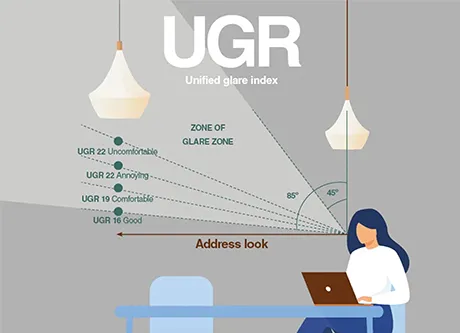
The Unified Glare Rating (UGR) quantifies discomfort glare on a scale from 10 (imperceptible) to 31 (intolerable). For indoor sports:
| Application | Recommended UGR |
|---|---|
| Recreational / training | ≤ 22 |
| Competition | ≤ 19 |
| TV broadcast | ≤ 19 |
Achieving low UGR requires a combination of fixture design (shielded optics, diffusers) and intelligent placement. Avoid mounting fixtures directly in the normal line of sight for players and spectators.
Pro Tip: Products like the Recolux E-line LED Lighting Control System offer 20 optical combinations with exceptional glare control and Ra >90 color rendering — ideal for competition-grade venues where both UGR and broadcast quality matter.
3. Color Rendering Index (CRI / Ra)
CRI measures how accurately a light source reveals colors compared to natural daylight (Ra = 100).
| Venue Level | Minimum Ra | Why |
|---|---|---|
| Recreational | ≥ 70 | Basic visibility |
| Competition | ≥ 80 | Accurate object recognition |
| TV Broadcast | ≥ 90 | Camera color fidelity; skin tones look natural on screen |
For any venue that films matches — even for local streaming — Ra ≥ 90 is strongly recommended. The cost difference between Ra80 and Ra90 fixtures has narrowed significantly over the past five years.
4. Flicker
Flicker — rapid, repetitive variation in light output — is invisible to the naked eye at high frequencies but can cause eye strain, headaches, and in extreme cases, the stroboscopic effect that makes fast-moving objects appear to jump.
LED sports fixtures must use flicker-free drivers with a percent flicker below 5% at all dimming levels. This is non-negotiable for venues with video recording or high-speed action.
How to Choose the Right LED Fixture for Sports Halls
The fixture type you select fundamentally shapes the lighting quality. For indoor sports facilities, the choice typically comes down to linear LED systems vs. traditional round high-bay fixtures.
Linear vs. Round High-Bay for Sports
| Criteria | Linear LED Fixture | Round High-Bay |
|---|---|---|
| Beam control | Superior — rectangular distribution matches court shape | Circular beam wastes light at court edges |
| Glare control | Better — long form factor reduces perceived brightness per unit area | Higher apparent brightness per source; harder to shield |
| Uniformity | Easier to achieve U₀ ≥ 0.7 with fewer fixtures | Requires more fixtures for same uniformity |
| Mounting flexibility | Suspended, surface, continuous line | Typically pendant-mounted only |
| Best for | Sports halls, gymnasiums, swimming pools | Warehouses, industrial facilities (not sports-optimized) |
Why the Recolux Lidu21 Is Purpose-Built for Sports
The Recolux Lidu21 Linear Fixture is engineered specifically for sports venues, with features that address the unique demands of athletic lighting:
Lumen range: 9,450 lm to 22,850 lm — a single product family covers everything from a school training hall to a professional competition venue
Multiple beam distributions: Narrow, medium, and wide-angle optics let you tailor the light pattern to ceiling height and court dimensions
Flicker-free driver: Eliminates the stroboscopic effect for high-speed sports and video recording
Modular design: Fixtures can be arranged in continuous lines or individual configurations
Beam angle selection guide for the Lidu21:
| Ceiling Height | Recommended Beam Angle | Typical Sport |
|---|---|---|
| 6–9 m (20–30 ft) | Wide (90°+) | School gymnasium, community hall |
| 9–14 m (30–46 ft) | Medium (60°) | Competition venue, larger sports hall |
| 14–18 m (46–59 ft) | Narrow (30°) | Indoor stadium, professional arena |
Pro Tip: For halls with ceiling heights between 8–12 m, specify a medium beam (60°) for the main playing area and wide beam (90°) for the perimeter and spectator zones. This layered approach — rather than using one beam angle across the entire venue — delivers better uniformity with fewer total fixtures.
Supporting Fixtures for Ancillary Areas
A complete sports facility lighting design must cover more than just the court:
| Area | Recommended Fixture | Key Requirement |
|---|---|---|
| Player corridors & walkways | N-line (IP54 trunking system) | Dust-protected, durable |
| Locker rooms & changing areas | LED Batten (Allnice or Tubes) | IP44 minimum, quick installation |
| Swimming pool deck | Tri-proof light (E-evolution / E-plus) | IP65+, corrosion-resistant |
| Spectator seating | E-line with wide-beam optics | Glare-controlled, dimmable |
| Equipment storage | LED Batten | Functional, cost-effective |
Lighting Layout & Installation Best Practices
A great fixture installed in the wrong position still produces poor results. Lighting layout is the difference between a venue that meets specification on paper and one that actually performs.
Mounting Configurations
Direct suspension (pendant mounting) is the most common approach for sports halls. Fixtures hang from the ceiling structure at a height that balances light distribution with structural access.
Side-mounted or wall-mounted arrangements work for smaller halls (badminton, squash) and venues with low ceilings where pendant mounting would create glare issues.
Continuous line mounting — connecting multiple linear fixtures end-to-end — is growing in popularity for sports halls. It creates an uninterrupted line of light that eliminates the dark gaps between individually mounted fixtures. Recolux Trunking Systems support this configuration with integrated cable management.
Layout Grid Principles
For a rectangular sports court, the most effective layout places fixtures:
Parallel to the long axis of the court — this aligns the rectangular beam pattern with the playing surface
Outside the court boundary lines — never directly above the playing area where they'd interfere with high balls or shuttlecocks
In 2–3 rows — the number of rows depends on court width; a standard basketball court (15 m wide) typically uses 2 rows; wider multipurpose halls may need 3
| Court Width | Recommended Rows | Typical Fixture Spacing (within row) |
|---|---|---|
| < 12 m (narrow hall) | 2 rows | 3–4 m |
| 12–18 m (standard) | 2 rows | 2.5–3.5 m |
| 18–25 m (wide multipurpose) | 3 rows | 3–4 m |
Rule of thumb: Fixture spacing within a row should not exceed 1.5× the mounting height above the playing surface to maintain uniformity.
Avoiding Glare in Practice
The most common glare source in sports halls is a fixture positioned within the player's normal field of view. For basketball players looking up toward the hoop, or badminton players tracking a high shuttlecock, any fixture mounted directly overhead or in the upward gaze zone creates problematic glare.
Mitigation strategies:
Mount fixtures above 6 m wherever possible
Use optics with UGR ≤ 19 for competition venues
Position fixtures outside the 60° cone from the player's primary gaze direction
Specify fixtures with deep shielding or louvered optics for low-ceiling venues
Control Systems for Multipurpose Sports Venues
A school gymnasium that hosts basketball practice in the morning, badminton club in the afternoon, and a community event in the evening needs fundamentally different lighting for each scenario. Smart control systems make this possible without compromising on quality.
Scene-Based Zoning
Divide the sports hall into independently controllable zones — typically 2–4 zones for a standard hall — with preset scenes for each sport configuration:
| Scene | Active Zones | Likely Lux Target | Application |
|---|---|---|---|
| "Basketball Full Court" | All zones | 500 lux | Match play |
| "Basketball Half Court" | Zones 1–2 | 500 lux | Training |
| "Badminton (4 courts)" | All zones, partial output | 300–500 lux | Club play |
| "Assembly / Event" | All zones | 200 lux | Non-sport use |
| "Cleaning / Maintenance" | Zone 1 only | 100 lux | After-hours |
DALI vs. 0-10V Dimming
| Protocol | Best For | Notes |
|---|---|---|
| DALI (Digital Addressable Lighting Interface) | Competition venues, multipurpose halls with complex zoning | Individual fixture addressing, bidirectional communication, scene recall, diagnostic feedback |
| 0-10V | Simple gymnasiums with basic dimming needs | Lower cost, group control only, analog signal — adequate for on/off + brightness adjustment |
For multipurpose halls, DALI is the recommended standard. The upfront cost premium (typically 10–15% over 0-10V) is recovered through energy savings from precise scene-based dimming and the flexibility to reconfigure zones without rewiring.
Sensors: Occupancy + Daylight Harvesting
Combining occupancy sensors with daylight harvesting delivers additional energy savings:
Occupancy sensors: Automatically reduce lighting to 20% or switch off when the hall is unoccupied for a set period (typically 15–30 minutes for sports halls)
Daylight sensors: In halls with skylights or windows, dim artificial lighting proportionally to available daylight — particularly valuable for daytime training sessions
Real-world data from retrofitted school sports halls suggests sensor integration alone reduces energy consumption by 35–50% beyond the baseline LED savings.
Cost Analysis & ROI of LED Sports Lighting
Let's run the numbers on a typical sports hall retrofit to understand the real financial picture.
Scenario: 800 m² School Gymnasium Retrofit
Baseline: 24 × 400W metal halide high-bay fixtures (existing) Proposed: 18 × 200W Lidu21 linear LED fixtures (new) Operating hours: 3,000 hours/year (8 hours/day, 6 days/week, plus evening events)
| Metric | Metal Halide (Existing) | LED (Proposed) |
|---|---|---|
| Connected load | 10.8 kW (24 × 400W + ballast) | 3.6 kW (18 × 200W) |
| Annual energy consumption | 32,400 kWh | 10,800 kWh |
| Annual electricity cost (@ $0.12/kWh) | $3,888 | $1,296 |
| Annual maintenance (lamp replacement, labor) | $1,200 | $0 (5-year warranty) |
| Total annual operating cost | $5,088 | $1,296 |
| Financial Metric | Value |
|---|---|
| Annual savings | $3,792 |
| Estimated installation cost (fixtures + labor) | 12,000–12,000–18,000 |
| Simple payback period | 3.2–4.7 years |
| 10-year total savings (with 3% energy escalation) | $43,000+ |
| Rebate/incentive potential (varies by region) | 2,000–2,000–5,000 |
Note: This calculation does not include the "soft" ROI from improved player experience, reduced injury risk from better visibility, or the ability to host higher-level competitions that better lighting enables. These are real — just harder to quantify.
The Hidden Cost of Poor Uniformity
Beyond the direct energy and maintenance savings, LED sports lighting eliminates a subtle but significant cost associated with metal halide: lumen depreciation asymmetry. Metal halide lamps degrade unevenly — some lose 30% of output within the first year while others lose 15% — creating patchy, non-uniform lighting long before anyone schedules a replacement.
By the time metal halide lamps are at 50% of rated life (typically 2–3 years in a sports hall), the on-court uniformity has often degraded below the competitive threshold without anyone noticing. Teams play in deteriorating conditions, training quality suffers, and eventually the facility loses the ability to host competitive events. The LED alternative maintains >90% of initial output (L90) for 50,000+ hours — roughly 17 years at 3,000 hours/year — with uniform degradation across all fixtures.
5 Common Sports Lighting Mistakes to Avoid
1. Using Industrial High-Bay Fixtures in Sports Halls
A warehouse high-bay light is designed to illuminate a static environment where goods sit on shelves. A sports hall is a dynamic environment where people track fast-moving objects in three dimensions. The beam patterns, glare characteristics, and mounting logic are fundamentally different. Industrial fixtures in sports halls produce harsh shadows, poor uniformity, and unacceptable glare. Specify sports-grade fixtures.
2. Ignoring Vertical Illuminance
Facility managers often specify only horizontal lux levels and call it done. For any sport involving a ball or shuttlecock above head height (badminton, volleyball, tennis, basketball), vertical illuminance is equally important. Without it, players lose track of the object against the ceiling. Always include vertical illuminance requirements in your specification.
3. Under-Specifying for Future Needs
A school gymnasium built for PE classes today might host regional competitions in three years. Installing a system designed for 300 lux when 500–750 lux will eventually be needed means tearing everything out and starting over. Design the mounting grid, electrical infrastructure, and control system for the highest use case you can reasonably foresee. You can always install fewer fixtures initially while leaving capacity for expansion.
4. Neglecting Swimming Pool Environmental Factors
Indoor swimming pools present unique challenges: high humidity (60–70% RH), chloramine-laden air that corrodes standard fixtures, and difficult maintenance access over water. Standard indoor fixtures fail rapidly in these conditions. Specify fixtures with IP65+ rating, corrosion-resistant materials (stainless steel mounting hardware, sealed housings), and design access for maintenance without draining the pool.
5. Skipping the Lighting Design Simulation
A specification sheet tells you what a fixture can do in isolation. A lighting design simulation (using DIALux, AGi32, or Relux) shows you what the complete system will do in your specific space — accounting for ceiling height, wall reflectance, obstruction shadows, and mounting positions. Never approve a sports lighting project without a simulation that demonstrates: (a) illuminance levels across the entire playing surface, (b) uniformity ratios, and (c) glare ratings from player and spectator positions.
Frequently Asked Questions
What is the recommended lux level for a school gymnasium?
For a standard school gymnasium used for PE classes and recreational sports, 300 lux with a uniformity ratio of U₀ ≥ 0.7 is the minimum recommended level. If the gymnasium hosts interscholastic competitions, upgrade to 500 lux. For venues that may host televised events in the future, design the infrastructure to support 750–1,000 lux, even if you install lower-output fixtures initially.
How many LED lights does a basketball court need?
A standard FIBA basketball court (28 m × 15 m) with 8–12 m ceiling height typically requires 12–18 linear LED fixtures arranged in two rows parallel to the court, assuming 150–200W per fixture delivering 20,000+ lumens each. The exact count depends on ceiling height, target lux level, beam angle, and fixture lumen output. A lighting design simulation is essential for accurate fixture counts.
Can I use the same LED fixtures for basketball and badminton in a multipurpose hall?
Yes, but you need a control system that supports scene-based zoning. Badminton requires higher vertical illuminance and typically lower mounting heights than basketball. The same fixtures can serve both sports if they support dimming and the layout accommodates both court configurations. DALI-addressable fixtures with preset scene recall are the preferred solution.
What IP rating do LED lights need for an indoor swimming pool?
Indoor swimming pool fixtures require a minimum of IP65 (dust-tight and protected against water jets). Additionally, the fixture housing and mounting hardware must be corrosion-resistant — chloramine vapor is highly aggressive to standard aluminum and steel. Products like the Recolux E-evolution and E-plus tri-proof lights are designed for these conditions with PC housings and sealed construction.
How long do LED sports lighting fixtures last?
Quality LED sports fixtures are typically rated at L90 >50,000 hours or L80 >100,000 hours. At 3,000 operating hours per year (typical for a busy sports hall), L90 translates to 16+ years before light output drops below 90% of the initial value. This is 5–8× longer than metal halide lamp life, and unlike metal halide, the degradation is gradual and uniform across all fixtures.
What is the payback period for LED sports lighting?
For a typical school gymnasium retrofit (replacing metal halide with LED), the simple payback period ranges from 3 to 5 years, depending on local electricity rates and operating hours. Including available utility rebates and incentives can reduce this to 2–3 years. Beyond the pure energy arithmetic, LED sports lighting eliminates annual lamp replacement costs and maintains uniform output across its entire service life.
Conclusion: Getting Your Sports Lighting Project Right
LED sports facility lighting is an investment that pays for itself — but only if the specification is right. A system designed for the wrong lux level, the wrong beam angle, or the wrong environmental conditions will underperform regardless of how efficient the LEDs are.
The path to a successful sports lighting project runs through five decisions:
Define the use cases: What sports, at what level, now and in the future?
Specify the right lux levels and uniformity ratios for each use case
Select sports-grade fixtures with appropriate beam angles, UGR control, and flicker-free drivers
Invest in a control system that supports scene-based zoning for multipurpose venues
Run a professional lighting simulation before approving any design
Recolux offers a complete portfolio of sports lighting solutions — from the purpose-built Lidu21 linear fixture with multiple beam distributions and flicker-free performance, to the E-line system with Ra >90 and 20 optical combinations for broadcast-ready venues, to IP65+ tri-proof fixtures for swimming pool and wet area applications. Every solution is backed by OEM/ODM customization capability for large-scale projects.
Ready to plan your sports facility lighting upgrade? Contact the Recolux engineering team for a complimentary lighting design consultation, including a DIALux simulation tailored to your venue's specifications.
Sources:
CIE 169:2005 — "Practical Design Guidelines for the Lighting of Sport Events for Colour Television and Filming"
EN 12193:2018 — "Light and lighting — Sports lighting"
IES RP-6-20 — "Recommended Practice: Lighting Sports and Recreational Areas"
U.S. Department of Energy, "LED Application Series: Outdoor Area Lighting" (accessed June 2025)
International Basketball Federation (FIBA), "Guide to Basketball Facilities — Lighting" (accessed June 2025)